LaserTek (Singapore) Pte Ltd

Installed base

Historic products

Every laser trim system LaserTek shipped from Series 2 onward, with the original datasheets. Many of these machines are still running in production today.

If you operate one of these, this page is here to help you identify what you have and what it can do. We continue to supply spare parts, calibration standards and service for them.

One platform underneath

The specifications below are identical on every machine in this archive — chip trimmers and functional trimmers alike, across every generation. That is why a probe card, a switching card or a set of calibration standards carries across the range, and why an operator trained on a Series 2 machine is already most of the way to running a Series 3.

Measurement system

Mode
Dual — force current and force voltage
Range
0.1 Ω – 30 MΩ (10 mΩ optional)
Accuracy
0.02 % midrange
Repeatability
0.01 % midrange
Resolution
0.005 %
Measurement time
50 µs
Calibration standards
6 pcs, 0.01 %
Guard drive current
100 mA
Guard offset
1 mV

Switching matrix

Pins per card
16
Lines per pin
3 — force, sense, guard
Switch type
Dry reed relay
Contact life
1 billion cycles
Insulation
> 10 GΩ
Switching time
200 µs

Beam delivery and motion

Beam positioning
Precision high-speed galvanometer
Positioning resolution
1.5 µm
Positioning repeatability
2.5 µm
Focus lens
Flat telecentric
XY resolution
1 µm
Theta control
Motorised

Facility requirements

Power
220 V AC, single phase, 10 A, 50/60 Hz
Compressed air
80 – 100 psi, 10 cfm
Vacuum
100 CFM factory vacuum — debris removal and substrate retention

Chip trimmer

Series 2

The generation that established the platform. Infrared at 1064 nm for thick film, green at 532 nm for thin, dual-carriage motion at 600 mm/s, and dual magazines with elevators. Pulse width is what separates the thick film variants — 30 ns on the J40 through to 150 ns on the LDP pair — and it is the parameter to match to your paste.

Series 2
ModelFilmMin chipWavelengthOutput powerPulse widthSpot sizeField sizeFootprintWeightSoftwareHandlingDatasheet
TF-3050 LDP10TQThick film0.04" × 0.02"1064 nm6 W @ 10 kHz150 ns18 – 40 µm12 × 90 mm2125 × 966 × 1858 mm1000 kgDOS (WinLts 2 optional)Dual magazines with elevatorsPDF · 0.6 MB
TF-3050 LDP15TQThick film0.04" × 0.02"1064 nm12 W @ 10 kHz150 ns18 – 40 µm12 × 90 mm2125 × 966 × 1858 mm1000 kgWinLts 2, Windows XPDual magazines with elevatorsPDF · 0.6 MB
TF-3050 J40Thick film0201 (0.02" × 0.01")1064 nm6 W @ 10 kHz30 ns18 – 40 µm12 × 90 mm1490 × 1028 × 1843.5 mm1000 kgWinLts 2, Windows XPDual magazines with elevatorsPDF · 0.3 MB
TF-3050G BL8SThin film0.04" × 0.02"532 nm1.5 W @ 20 kHz7 ns8 – 10 µm12 × 75 mm1490 × 1028 × 1843.5 mmDOSDual magazines with elevatorsPDF · 0.9 MB
TF-2010G Y70Thick film01005 (0.01" × 0.005")532 nm3 W @ 7.5 kHz70 ns @ 1 kHz11 – 25 µm12 × 75 mm1820 × 1070 × 2050 mmLTS2010, Windows XPRotary control, two magazine setsPDF · 0.7 MB

TF-3050 LDP10TQ

150 ns · 6 W @ 10 kHz
  • Longest pulse of the Series 2 range at 150 ns — energy is delivered over a long enough window to cut coarse thick film without chipping the ceramic beneath
  • Largest frame in the archive, with the laser supply in its own bay for easier service access
  • The last machine shipped with DOS application software; WinLts 2 was offered as an upgrade
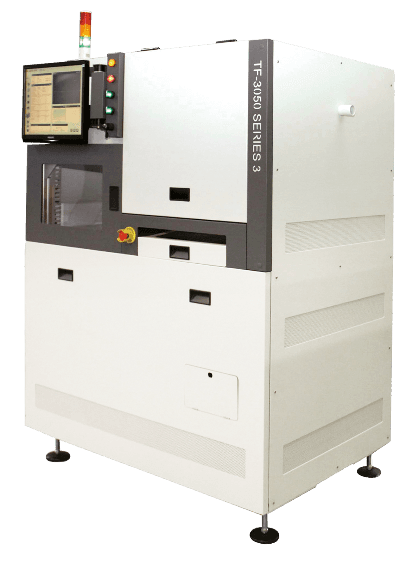
TF-3050 LDP15TQ

150 ns · 12 W @ 10 kHz
  • 12 W average power — double every other machine of the generation, and the highest in the archive alongside the Series 3 LDP15TQ
  • Same 150 ns pulse as the LDP10TQ, so kerf character is unchanged; the gain is purely cutting rate
  • Shipped with WinLts 2 on Windows XP as standard rather than as an option

TF-3050 J40

30 ns · 6 W @ 10 kHz
  • 30 ns pulse — five times shorter than the LDP machines, putting less heat into the substrate and leaving a cleaner kerf edge
  • First of the family specified for 0201 as well as 0.04" × 0.02"
  • Built-in pattern recognition for auto-compensation, and intelligent sensors that detect and isolate defective parts
  • Roughly 30 % narrower than the LDP frames at 1490 mm

TF-3050G BL8S

7 ns · 1.5 W @ 20 kHz
  • 8 – 10 µm spot — the finest in the archive, roughly a quarter of the 1064 nm machines' 18 – 40 µm, which is what thin film geometry demands
  • 7 ns pulse at 532 nm: short and green, so very little thermal load reaches the NiCr or TaN film
  • TEM₀₀ beam over a 1 – 100 kHz frequency range
  • Carriages on independent air-cooled brushless DC servo stages, with a pneumatically counter-balanced prober
  • Takes 50 × 60 mm and 60 × 70 mm substrates

TF-2010G Y70

70 ns @ 1 kHz · 3 W @ 7.5 kHz
  • The only machine in the archive rated for 01005 as well as 0201 — the finest chip geometry LaserTek shipped in this era
  • Wireless probe card with very low contact resistance and shielded cabling, for the most stable measurement of the generation
  • Rotary magazine control rather than dual elevators, cutting idle time between substrates
  • Pattern-recognition alignment and sensors that detect part breakage along both edges
  • 12 switching cards as standard, where the TF-3050 machines ship with 10

Chip trimmer

Series 3

A new handler rather than a new laser. The step-and-repeat stage runs at 1500 mm/s with 1.2 G acceleration and a 30 ms index, fed from a 360-piece 0402 cartridge, and the machine shed 100 kg and 180 mm of width in the process. The five variants are one machine offered at five pulse widths, from 50 ns to 150 ns.

Series 3
ModelFilmMin chipWavelengthOutput powerPulse widthSpot sizeField sizeFootprintWeightSoftwareHandlingDatasheet
TF-3050 LEP50Thick film0402 cartridge (360 pcs)1064 nm6 W @ 10 kHz50 ns18 – 40 µm12 × 90 mm1310 × 1028 × 1800 mm900 kgWinLts 3, Windows XPStep & repeat, 1500 mm/s, single stacked elevatorPDF · 1.3 MB
TF-3050 LEP60/CThick film0402 cartridge (360 pcs)1064 nm6 W @ 10 kHz60 ns18 – 40 µm12 × 90 mm1310 × 1028 × 1800 mm900 kgWinLts 3, Windows XPStep & repeat, 1500 mm/s, single stacked elevatorPDF · 1.3 MB
TF-3050 LEP70Thick film0402 cartridge (360 pcs)1064 nm6 W @ 10 kHz70 ns18 – 40 µm12 × 90 mm1310 × 1028 × 1800 mm900 kgWinLts 3, Windows XPStep & repeat, 1500 mm/s, single stacked elevatorPDF · 1.3 MB
TF-3050 LDP10TQThick film0402 cartridge (360 pcs)1064 nm6 W @ 10 kHz150 ns18 – 40 µm12 × 90 mm1310 × 1028 × 1800 mm900 kgWinLts 3, Windows XPStep & repeat, 1500 mm/s, single stacked elevatorPDF · 1.3 MB
TF-3050 LDP15TQThick film0402 cartridge (360 pcs)1064 nm12 W @ 10 kHz150 ns18 – 40 µm12 × 90 mm1310 × 1028 × 1800 mm900 kgWinLts 3, Windows XPStep & repeat, 1500 mm/s, single stacked elevatorPDF · 1.2 MB

TF-3050 LEP50

50 ns · 6 W @ 10 kHz
  • Shortest pulse of the Series 3 range at 50 ns — the cleanest cut where trim tolerance matters more than removal rate
  • Step-and-repeat stage at 1500 mm/s and 1.2 G with a 30 ms index — a step change over the 600 mm/s carriages of Series 2
  • Smallest and lightest machine in the archive at 1310 mm and 900 kg

TF-3050 LEP60/C

60 ns · 6 W @ 10 kHz
  • 60 ns sits between the LEP50 and LEP70 — the middle setting when a paste cuts poorly at 50 ns but does not need 70 ns
  • Identical platform, handler and measurement chain to the rest of Series 3, so the choice is purely a process one

TF-3050 LEP70

70 ns · 6 W @ 10 kHz
  • Longest of the LEP pulse options at 70 ns — more energy per pulse for thicker or more resistant pastes, while staying well short of the 150 ns LDP machines
  • Same throughput as the rest of Series 3; the trade is cut character, not rate

TF-3050 LDP10TQ

150 ns · 6 W @ 10 kHz
  • Series 2 thick film cutting character — the same 150 ns pulse — on the faster, smaller Series 3 step-and-repeat platform
  • The natural upgrade path for a shop running a Series 2 LDP10TQ that wants throughput without requalifying the trim

TF-3050 LDP15TQ

150 ns · 12 W @ 10 kHz
  • The most capable machine in the archive on paper: 12 W at 150 ns on the Series 3 platform — highest power and fastest handler together
  • Suited to the heaviest thick film removal where cycle time governs

Chip trimmer

Series 5

One variant survives in the archive. Its published specification matches the Series 2 J40 closely enough that we flag it rather than present it as settled.

ModelFilmMin chipWavelengthOutput powerPulse widthSpot sizeField sizeFootprintWeightSoftwareHandlingDatasheet
TF-3050 X30Thick film0201 (0.02" × 0.01")1064 nm6 W @ 10 kHz30 ns18 – 40 µm12 × 90 mm1490 × 1028 × 1843.5 mm1000 kgWinLts 2, Windows XPDual magazines with elevatorsPDF · 0.3 MB

TF-3050 X30

30 ns · 6 W @ 10 kHz
  • 30 ns at 1064 nm with 0201 capability and built-in pattern recognition
  • Rated from ohms to megohms rather than milliohms — the headline claim differs from the otherwise identical Series 2 J40 sheet

The archived Series 5 X30 datasheet is specification-identical to the Series 2 J40 apart from the resistance-range wording. Confirm with engineering before quoting this sheet as the Series 5 specification.

Functional trimmer

TF-5900 platform

A different machine for a different job, and now out of production. Where the chip trimmers scan a 12 × 90 mm strip and measure one resistor at a time, the TF-5900 scanned a 50 × 50 mm area and drove the whole board through a GPIB instrument rack — power supply, multimeter, function generator — trimming while the device was switched on and watching its output settle. Two frames were built: the auto-handler A, also sold earlier as the Series 2 Y70, and the lighter single-carriage L.

ModelFilmMax panelWavelengthOutput powerPulse widthSpot sizeField sizeFootprintWeightSoftwareHandlingDatasheet
TF-5900 AThick film5" × 5" panel1064 nm6 W @ 10 kHz70 ns20 – 40 µm50 × 50 mm1865 × 2355 × 1952 mm1470 kgLTS2010, Windows XPAuto handler, dual carriage, two custom magazinesPDF · 0.8 MB
TF-5900 LThick film4" × 4" panel1064 nm6 W @ 10 kHz70 ns20 – 40 µm50 × 50 mm1720 × 1070 × 1853 mm1010 kgLTS2010, Windows XPSingle carriage, pneumatic pick and placePDF · 0.3 MB
TF-5900 A

TF-5900 A

70 ns · 6 W @ 10 kHz
  • The auto-handler frame of the functional platform: dual carriage, conveyor and transfer zone, two custom magazines
  • Also shipped as the Series 2 Y70 — the same machine under an earlier designation, so both datasheets describe one nameplate
  • GPIB interface and 7U instrument rack for trimming devices under power and measuring their final output
  • 50 × 50 mm field with a 255 mm lens — an area rather than the 12 × 90 mm strip the chip trimmers scan

TF-5900 L

70 ns · 6 W @ 10 kHz
  • Single-carriage variant: same laser, optics and measurement chain as the TF-5900A in a frame 460 kg lighter and 1285 mm shallower
  • Takes 4″ × 4″ panels rather than 5″ × 5″ — the trade for the smaller footprint
  • Keeps the GPIB active-trim capability, so choosing it over the A was a floor-space decision rather than a capability one

Every figure on this page is transcribed from the original LaserTek datasheets, linked above. Where a datasheet is internally inconsistent, we say so rather than resolve it silently. None of these machines remain in production; their specifications are published here for identification, spare parts and service.

Ask about parts or service